
On National Council of Social Service (Amendment) Bill
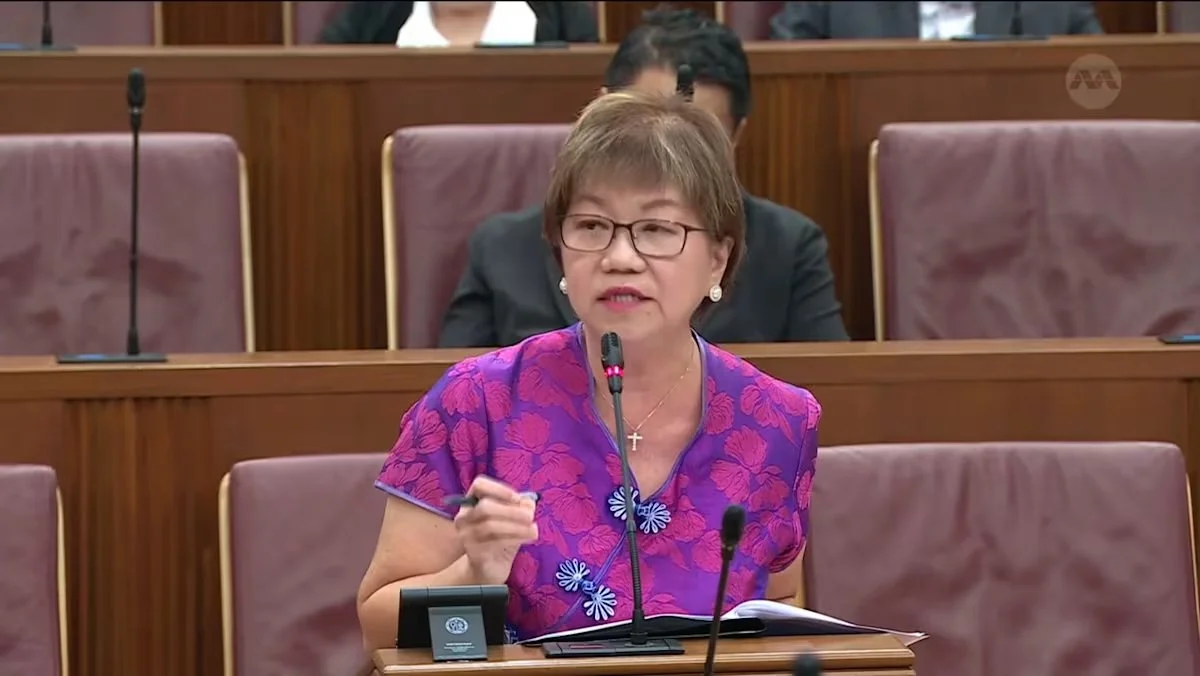
Watch my full speech here: https://www.channelnewsasia.com/watch/denise-phua-national-council-social-service-amendment-bill-5855281
Image credit: CNA
Speaker, Sir, I rise to state my support for the Bill. I declare I am an active volunteer in the disability sector for more than 25 years and I currently chair two large autism charities, both are NCSS members, and I help to supervise services from early intervention to special schools to services for adults.
In my job as Mayor of Central District Community Development Council (CDC), my team and I also partner many from the people, public and private sectors. We work with agencies and donors to support families in need, especially those living in rental flats. We also work with hundreds of organisations, including corporates and foundations, to raise disability awareness and dignity, through example, The Purple Parade movement and The Purple Symphony orchestra. And NCSS is one of our key partners.
Over the years, I have seen first-hand the good work of the NCSS and its partnership-oriented approach across different generations of leadership – Ms Anita Fam, Mr Hsieh Fu Hua, Ms Ang Bee Lian, Ms Tan Li San – and many more.
What has historically distinguished NCSS is just the policies it advanced or the funds that it administered, but its ethos as a membership-based organisation. NCSS had for years worked with agencies, then known as voluntary welfare organisations (VWOs) and now SSAs, they work with them, rather than over them. NCSS recognised that effective social service delivery depends not just on structures and systems and power and hierarchy, but also on trust: trust of character and competence, professional judgement, morale and sustained relationships on the ground.
This context matters, because the Bill before us marks a clear institutional evolution. The NCSS (Amendment) Bill formally expands NCSS' statutory functions as a system steward of the social service sector. I support this direction.
Our social service ecosystem today is far more complex than when the principal Act was first enacted three decades ago. The landscape is shaped by an ageing population, rising mental health needs, greater diversity amongst vulnerable groups, post-school cliff effects faced by the disabled adults, technological impact and higher expectations for accountability and outcomes.
In such an environment, a stronger and better-coordinated sector is not an option, it is a necessity. And this Bill recognises that reality, and for that, I welcome the Bill. However, as NCSS assumes a more formalised system-steward developer role, it becomes even more important that institutional strengthening does not dilute the partnership-driven ethos and culture that NCSS is known for.
It is from this perspective that I will highlight both the strengths of the Bill and several areas that merit careful attention.
First, on three key positives of this Bill.
One, clearer mandate and stronger governance. Sir, clause 6 of the Bill replaces sections 6 to 12 of the Act and introduces a new section 11 that sets out an updated set of objectives and functions of the Council. These reflect and strengthen the role of the Council as sector developer for the social service sector.
It gives statutory clarity to the Council's role as a strategic sector developer, beyond that of a convenor or a grant administrator. The Bill expressly provides for functions such as advising Government, coordinating social service provision, setting standards, building sector capability, mobilising resources and supporting the implementation of national social policy. This clarity matters. It provides legitimacy for NCSS to act across boundaries and also provides a stronger governance basis for it to steward the sector responsibly and strategically. So, that is good.
Key positive two: stronger coordination and long-term system stewardship. The Bill also enables NCSS to better address cross-cutting needs that spans agencies and life stages, and to reduce fragmentation within the sector. Over time, stronger coordination can help minimise duplication, close service gaps and create clearer and more navigable service pathways, especially for individuals and families who require support from multiple touchpoints. In this regard, the Bill can move the sector towards a more integrated and user-centered system.
The third key positive: strengthened capability development and data-informed practice. Sir, the Bill further strengthens NCSS' mandate in workforce and organisational capability development. This includes training and professional development, development of specialised skills, leadership and talent pipelines. The Bill also clarifies the Council's role in collecting, analysing and using sector-wide data for planning, evaluation and research, building on improved digital and data capabilities.
Taken together, these provisions support a more capable, evidence-informed sector – one that is better equipped to adapt, to learn and to respond to evolving social needs in a sustainable way, and I applaud these directions and recognise the value that they bring to a more complex and demanding social service environment. But the very strengthening of Council's statutory role also raises important questions of balance, boundaries and execution. As we strengthen the system, we must not build this safety net with the chains that bind the very hands that weave it. It is to these considerations that I now turn.
Sir, I would like to next raise four areas of concern and some of the implementation risk.
Concern number one: risk of over-centralisation. A stronger NCSS can improve coherence coordination, but if it is not carefully calibrated, it may also lead to unintended over-centralisation of decision-making, resources and influence. This will not bode well for the sector. For larger SSAs, closer alignment to NCSS frameworks may result in a greater emphasis on compliance over innovation, increased risk aversion and also growing bureaucratic overheads.
I recall an instance where, sometime back, in submitting a tender for a facility for one of our charities, my team and I were required to comply with the norms and specifications that were decades old. We were a bit stuck because non-compliance would render our tender ineligible, yet compliance would constrain our ability to innovate or pilot new models. This illustrates how rigid requirements and compliance can sometimes discourage innovation and progress.
For smaller SSAs, stronger NCSS stewardship can bring benefits, such as access to shared services and professionalisation; and the Sun Ray Scheme, that many spoke about. However, uniform standards often assume an administrative scale that sometimes, smaller agencies simply do not have. This may result in disproportionate compliance burdens, pressure to conform to standardised templates and reduced responsiveness to local community realities. The risk, therefore, is over-uniformity due to over-centralisation.
Concern number two: rising compliance and administrative burdens. The Bill's strengthened governance and data obligations may increase reporting, audits and evaluation requirements. Today, funders and donors rightly expect outputs and outcomes; not to mention impact, the latest buzzword. Impact, which is the latest ambitious expectation. Some of these measures are often difficult to attribute, to isolate and to track meaningfully, especially in complex social settings.
Accountability is necessary, but it is not cost-free. From experience, the charities I serve already incur significant expenditures on internal audits and external audits, procurement systems and compliance processes – costs that involve not just financial outlays, but also substantial manpower and administrative effort.
Many SSAs are already operating under severe manpower constraints, high caseloads, burnout and staff turnover. Compounding this, many of these compliance costs must be supported through donor funds, and we know that many donors are often reluctant to fund overheads and want to fund only direct service costs.
It is, therefore, important that in strengthening governance, we recognise the true cost of accountability and compliance, and avoid adding unnecessary administrative strain that will divert energy away from frontline service delivery. This caution applies not only to administrators in the social service sector, but also across the health, ageing and special education domains.
Concern three: safeguarding diversity and innovation. Many of Singapore's most impactful social interventions began as small, ground-up initiatives. Pathlight School, which I co-founded, started that way. Started by volunteers, professionals who are professionals and also parents. We started only with 41 students, and thanks to the Ministry of Education, NCSS and SG Enable, it is now a large and popular school serving thousands.
Happee Hearts Movement, started by Dr Chen Shi Lin, started modestly and is still that way, but nimble. So is Helping Joy – I think they are featured in the newspapers these days – started by Steven Goh, to help clear hoarding homes and thankfully, also a partner of Central Singapore CDC. Both Dr Chen and Mr Goh are nominees for the Singaporean of the Year Award.
If agencies, such as NCSS' expanded statutory powers, unintentionally privilege scale, maturity or compliance over proximity and trust, we risk losing such grassroots energy, and cultural and linguistic diversity, and high-touch relational approaches. And missing contributors, such as Dr Chen and Mr Goh.
Over time, if we are not careful, agencies may default to policy-safe, standardised interventions, rather than develop innovative models to respond to emerging needs. And therefore, a healthy social service ecosystem requires not only strong institutions, but also space for diversity, for dissent and experimentation; without compromising quality and due diligence.
Concern number four: system sensing, how NCSS will identify emerging gaps. A stronger mandate and better data capabilities do not automatically translate into better system intelligence. The social service landscape spans multiple vulnerable groups with overlapping, evolving and often invisible needs. Many critical gaps surface first through frontline practitioners, caregivers, volunteers and even small niche organisations – long before they appear in formal data sets.
The key question, therefore, is, how will NCSS know, early and hopefully, accurately, where these urgent gaps lie, particularly when needs are localised, emergent or poorly captured by existing reporting frameworks? And how will it know who to trust, in character and competence to work with? So, a system steward, like NCSS, must, therefore, be designed not only to coordinate, but to listen deeply, sense early and respond proportionately.
And next, on clarifying NCSS' role within the broader care ecosystem. Sir, the four concerns I raise lead naturally to questions about role clarity. Singapore's care ecosystem today is complex. It is organised along different population and service domains. For instance, those of us, as MPs, would know, seniors' services are largely coordinated by the Agency for Integrated Care under MOH; then, disability services are supported by SG Enable and MSF's Disability Office; family services and social service offices fall under MSF; and then, recently, I just heard, volunteer mobilisation, now, it is not just by NCSS, but it is also previously by National Volunteer and Philanthropy Centre (NVPC) and the Prime Minister also just instructed the CDCs to look at increasing volunteers.
With this Bill strengthening the Council's functions in coordination, capability development, data use and system stewardship, there needs to be clarity on how these roles and agencies intersect. I think there will be overlaps, but the overlaps with existing lead agencies must be addressed in practice, especially in areas, such as needs assessment, service planning, capability development and data reporting.
Beyond relying on nominated Board members and occasional meetings of members, there should be, in NCSS, a systemic and structured platform to sense, identify, prioritise, plan, coordinate and resource the critical gaps with the other agencies, across the sector for both existing and emerging gaps.
And with that, I have three questions for the Minister, for clarification.
The first is to do with governance and innovation. How will the Bill be implemented to ensure that stronger governance and funding relationships do not inadvertently encourage compliance-driven behaviour, stifle innovation or add unnecessary layers of bureaucracy within the social service sector?
My second question is about proportionate compliance and reporting. How will compliance and reporting requirements be calibrated to the size, to the capacity and maturity of the SSAs in this sector, so that both large and small SSAs are not overburdened by administrative costs that detract from frontline service delivery?
My third clarification question is this: it has to do with managing overlaps and identifying system gaps. What system and what structured platform will be put in place to sense, to identify, to prioritise, to plan, to coordinate and to resource critical gaps, both existing and emerging, across the sector? How will NCSS and existing agencies work together to ensure that the most significant and urgent service gaps, such as that in adult disability, the impact of technology, artificial intelligence (AI), AI-driven robots, which really kept some of us worried because these technologies will take away some of the jobs that we are trying to create for the disabled, for the elderly. How will all these gaps be surfaced such that they will be addressed in the sector, in a coordinated and effective and timely manner?
In conclusion, Sir, this Bill marks an important step forward in how Singapore supports and governs its social service sector. It strengthens coordination, builds capability and also enables a more data-informed system – one that seeks to leave fewer people behind in our society, in our country. But at the same time, as a framework Bill, much will depend on how the Council's powers are exercised through subsequent regulations and implementation. Its true test will, therefore, lie not in the passage of the Bill today, but in how it is applied in practice after today.
As we strengthen NCSS and the system around it, we must also preserve the diversity, the humanity and the community-driven spirit innovation that give the sector its strength. So, in conclusion, with appreciation for the dedicated work of NCSS, Government partners, MSF and all the SSAs, and with a call for continued partnership and mutual trust, I do support the Bill. Thank you very much for doing this.